

Powerful Ethereum History Dream and Boom
Every great technological revolution is born from frustration from the sense that existing tools however wonderful have a glass ceiling. The automobile was born from the slowness of the horse. Email from the delay of the mailman. And Ethereum the decentralized world computer was born from the elegant but rigid chains of Bitcoin.
To understand the magnitude of the conceptual leap that Ethereum represented we must transport ourselves to the digital world of 2013 where there was only one sovereign king Bitcoin.
The World Before Ethereum The Brilliance and the Limits of Bitcoin
Satoshi Nakamoto’s creation in 2009 was and still is a masterpiece of cryptography game theory and social engineering. Bitcoin solved a problem that had haunted computer scientists for decades the double spending problem. It created for the first time a form of native internet money that was scarce transferable without intermediaries and resistant to censorship from any government or bank. It was digital gold.
Bitcoin functioned as an incorruptible ledger distributed across thousands of computers worldwide. Its only purpose was to record transactions of its currency BTC and it did so with almost paranoid security. This robustness was largely due to its deliberate simplicity. Bitcoin’s programming language known as Script was intentionally limited. It was not Turing complete which means it could not be used to solve any computational problem. It was like a pocket calculator perfect for doing one thing adding and subtracting value but useless if you wanted to write a novel or program a video game.
This limitation was a design feature not a flaw. But for a 19 year old prodigy a Russian Canadian programmer and writer named Vitalik Buterin it was a missed opportunity. Vitalik cofounder of the influential Bitcoin Magazine was immersed in the ecosystem. He saw how innovative projects like Namecoin for decentralized domain name registration or Colored Coins for creating assets on Bitcoin had to perform technical feats and build complex and inefficient protocols on a foundation that was not designed for them.
Vitalik’s frustration crystallized into a question that would forever change the course of blockchain technology What if instead of having a blockchain for each application we could have a single universal blockchain on which anyone could build any application
The Vision A Computer for the World
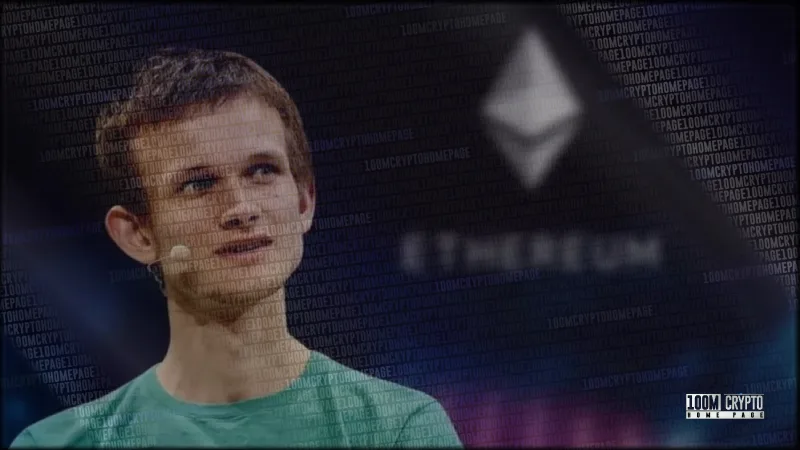
At the end of 2013 Vitalik published a document that would become the manifesto of a new era the Ethereum white paper. It did not propose a simple improvement of Bitcoin it proposed a completely new paradigm. His central idea was to create a platform with a built in Turing complete programming language allowing any developer in the world to write and deploy smart contracts and decentralized applications dApps.
Imagine a traditional contract a legal document that depends on lawyers to draft it and on a judicial system to enforce it. Now imagine that contract as a computer program. A smart contract is code that self executes when certain predefined conditions are met. For example IF team A wins the match THEN transfer 10 ETH to Bob’s account. This code lives on the blockchain which makes it:
- Immutable Once deployed nobody can alter it
- Transparent Anyone can audit its logic
- Autonomous It does not need an intermediary to run The code itself is the arbiter
Vitalik’s vision was not to create a better cryptocurrency It was to build a decentralized world computer A layer of trust and execution for the entire internet a platform where innovation would not have to ask for permission
The Foundation A Team of Titans and Clashing Visions
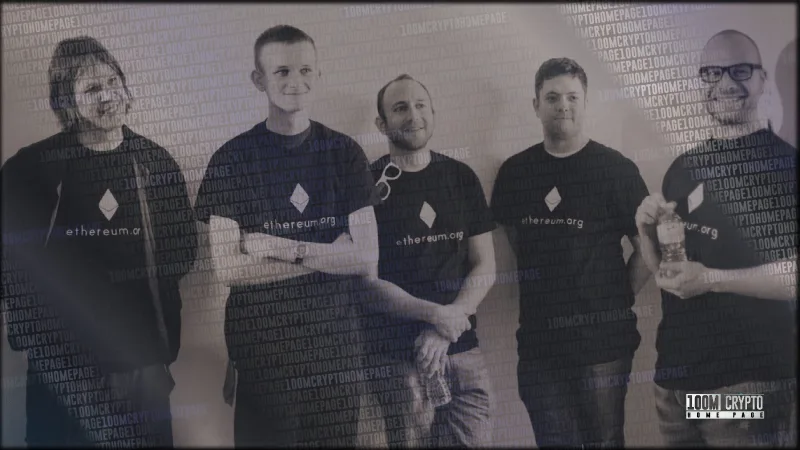
Such a powerful idea inevitably attracts brilliant minds. Soon a heterogeneous group of pioneers joined Vitalik to turn the white paper into reality. This group known as the eight cofounders was a volatile mix of technical geniuses entrepreneurs and digital philosophers
- Vitalik Buterin The visionary and spiritual leader
- Gavin Wood A British programmer who became the technical engine of the project Wood coded the first functional implementation of Ethereum wrote the Yellow Paper the formal technical specification of the Ethereum Virtual Machine or EVM and coined the term Web3 to describe the decentralized internet that Ethereum would make possible
- Charles Hoskinson An American mathematician who brought academic rigor but had a more commercial vision of the project He later founded Cardano
- Joseph Lubin A former Goldman Sachs executive who saw Ethereum’s immense business potential and went on to found ConsenSys one of the largest and most influential development companies in the ecosystem
- Anthony Di Iorio A Canadian entrepreneur who was one of the main early funders and a key connector in the early days
- Mihai Alisie Amir Chetrit and Jeffrey Wilcke completed this group of founders each contributing crucial capital connections or development skills
As in every origin story of a great technology tensions soon arose. The main debate revolved around the very nature of Ethereum. Should it be a for profit company selling licenses of its technology Or should it be a nonprofit foundation like the Linux Foundation dedicated to safeguarding an open and neutral protocol for the common good
Vitalik and Gavin Wood fervently defended the nonprofit model. They believed that for Ethereum to become public and global infrastructure it had to be free from commercial interests. Others like Hoskinson advocated for a more corporate structure. These philosophical differences proved irreconcilable leading to the departure of some members. In the end the vision of a neutral organization prevailed and the Ethereum Foundation was established in Zug Switzerland.
To fund the colossal challenge of building the world computer a crowdsale was launched in the summer of 2014. The network’s native token Ether ETH was sold in exchange for Bitcoin. Ether was not just a currency it was designed as the gas or fuel of the network. Every calculation every transaction every smart contract execution would require a small amount of ETH to pay those who secured the network.
The sale was a resounding success. Over 42 days 31591 BTC were raised valued at about 18.4 million dollars at the time. The price per ETH was about 0.31 dollars. The global community had funded the dream.
On July 30 2015 the promise became reality. The genesis block was mined and the first version of Ethereum named Frontier went live. Its name was a statement of intent it was a basic network a wild and dangerous frontier with a command line interface designed only for the boldest developers. The world computer had been turned on.
The Trial by Fire The Rise and Fall of The DAO
With the network running experimentation began. But the application that would define this era both for its ambition and for its tragic end was The DAO.
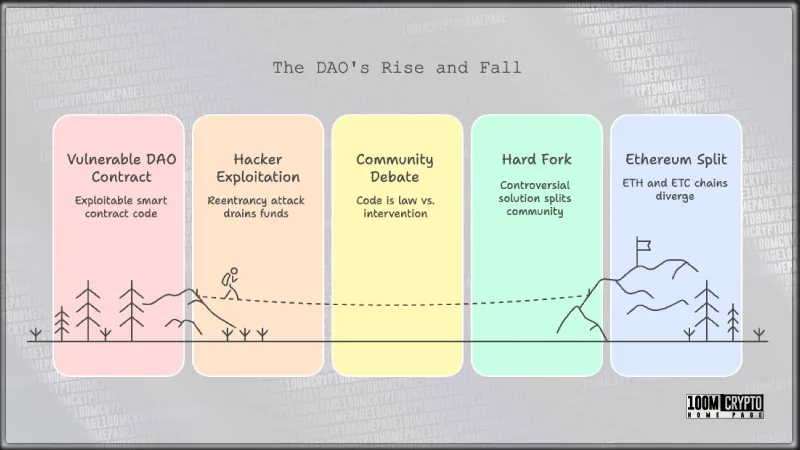
The DAO Decentralized Autonomous Organization was a concept that seemed straight out of a science fiction novel. It was a decentralized venture capital fund without directors without offices without a bank account. It was literally a set of smart contracts living on Ethereum. Anyone could send ETH to The DAO’s contract and receive in return DAO tokens which granted voting power. Entrepreneurs submitted proposals the community of token holders voted and if a proposal won the contract automatically released the funds.
The concept captivated thousands of people. In a public sale that lasted 28 days in 2016 The DAO raised more than 12.7 million ETH worth about 150 million dollars at the time. It was the largest crowdfunding campaign in history. About 14 percent of all Ether in circulation was locked in this single contract. The DAO was the killer app the ultimate demonstration of Ethereum’s power.
And then on June 17 2016 disaster struck. An anonymous attacker found a vulnerability in The DAO’s code. Exploiting a flaw known as a reentrancy attack the hacker managed to trick the contract into repeatedly sending him ETH before it updated its own balance. He began draining millions of dollars into a child DAO under his control.
The community panicked. They faced an existential dilemma that struck at the heart of blockchain ideology. On one side was the principle of code is law. The blockchain was immutable. Transactions once confirmed were irreversible. The attacker though malicious had played by the rules of the code however flawed. On the other side morality and common sense demanded intervention to stop a 50 million dollar theft that threatened to destroy trust in the entire ecosystem.
The debate was fierce. Did the community have the right to intervene and rewrite history After weeks of discussions a drastic and controversial solution was proposed a hard fork. A hard fork is a software update that creates a new chain separate from the original. This specific fork contained a piece of code that moved all of The DAO’s funds including the stolen ones to a new contract that would allow the original investors to recover their money.
Most of the community miners developers and users supported the proposal. At block 1920000 the hard fork was executed. The chain that implemented the reversal became what we now know as Ethereum ETH. However a purist minority that defended the immutability of the chain as a sacred and unbreakable principle refused to accept the change. They continued operating on the original chain which still contained the hack. That chain survived and is known today as Ethereum Classic ETC.
The DAO hack was Ethereum’s first great existential crisis a painful lesson about the responsibility that comes with creating autonomous systems.
The Phoenix The ICO Gold Rush
After overcoming The DAO trauma Ethereum not only recovered but also found its first major use case with global market fit Initial Coin Offerings ICOs.
The catalyst was the creation of a technical standard called ERC 20. This standard was essentially a universal template for creating new tokens on the Ethereum network. It provided a basic set of rules that ensured any ERC 20 token was compatible with wallets exchanges and other contracts on the network. It was a moment equivalent to the standardization of the shipping container in global trade suddenly everything fit.
Thanks to ERC 20 any project with an idea and a white paper could create its own token and sell it directly to the public to fund its development bypassing venture capitalists and banks. What followed in 2017 was an explosion of speculative activity without precedent a true digital gold rush the ICO Boom.
Hundreds of projects launched their ICOs raising millions of dollars in minutes. Demand for ETH the main currency used to participate in these sales skyrocketed to astronomical levels. The price which had started 2017 below 10 dollars catapulted in a parabolic curve that peaked at nearly 1400 dollars in January 2018.
Ethereum had proven to be much more than a technical experiment. It was a global platform for capital formation permissionless and worldwide in reach. Although many projects from the ICO era turned out to be smoke this frenetic phase demonstrated Ethereum’s power and laid the groundwork for the revolutions to come decentralized finance and NFTs. The world computer was not only on it was about to change the rules of finance and culture forever.
Read next: 👉 Part 2: Inspiring Ethereum History Winter and Summer
Powerful Ethereum History Dream and Boom
#100MCrypto #Ethereum #VitalikButerin #SmartContracts #Bitcoin #Blockchain #ICO #DeFi #Web3 #CryptoHistory
Looking for more?
Dive deeper into the crypto world:
• Stay updated with our Blog
• Find top influencers and exclusive deals
• Discover the leading crypto companies
• Learn the basics (and beyond) in our Crypto Academy
🧭 Already building something serious in Web3?
Make your project visible to the right audience — permanently.
👉 Secure your space on 100MCrypto
